


People generally avoid disgusting things, but what if you’re deciding whether to eat them? At an experimental buffet, people spent more time looking at edible insects and other unusual snacks. However, they only rated the insects as more disgusting. This suggests that novelty drives looking behaviour when we’re foraging, and can even overrule the tendency to look away from disgust elicitors.
Studying foraging behaviour at a buffet
Dr Jonas Potthoff visited the lab in 2023 (exactly two years ago!) to conduct two studies on the role of disgust in eating insects. The first of these studies came out this week in the journal Food Quality and Preference.
Jonas constructed a buffet table with common snacks, uncommon snacks (to our UK and Austrian participants), insect snacks (also uncommon here!), and plates with non-food control items. He used a wearable eye tracker to measure participants’ looking behaviour, and also asked people to rate their disgust and desire to eat all the available foods. At the end of the study, people were also allowed to eat anything they wanted. (And the insects were quite tasty!)
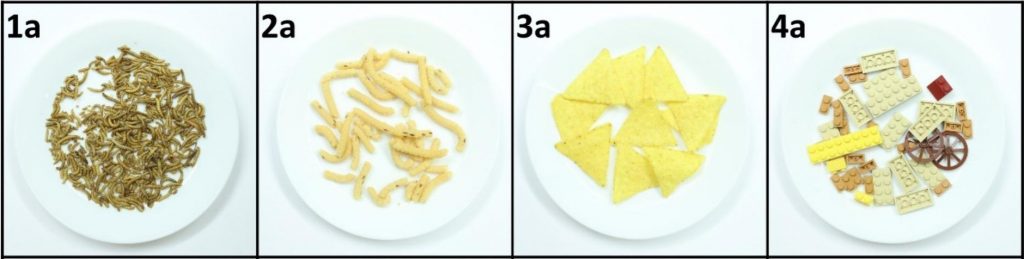
Insect, novel, and familiar snacks; and a non-food control.
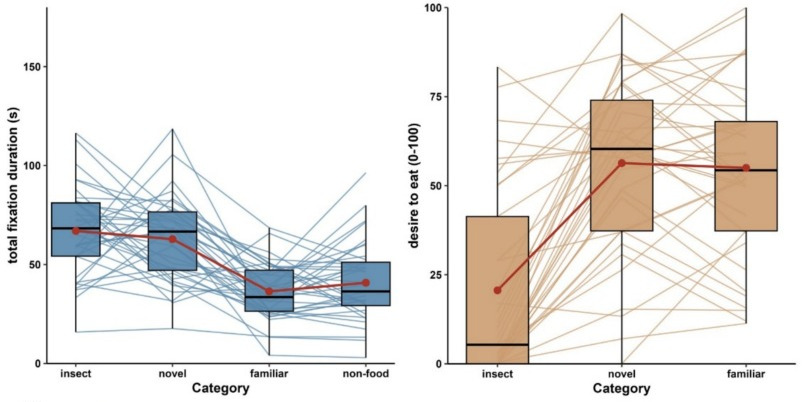
We found that participants showed the longest overall dwell time for insects and other uncommon snacks, and much less for familiar snacks and non-food items. This suggests that novelty attracted people’s attention, likely to allow them to make a more informed decision on whether or not to eat the unusual snacks.
Participants rated the insect snacks as more disgusting and they indicated a lower desire to eat them. However, they rated the other novel snacks about as low on disgust as the familiar snacks, and their reported desire to eat them was also about the same. This suggests that insects weren’t necessarily rejected out of “neophobia” (a fear of the new), but rather due to their creepy-crawly nature.
In many other studies from our lab, we find that people avoid looking at gross things. Disgust elicitors like bodily effluvia, for example, are avoided even after trying to pay people for it! (See Dalmaijer et al., 2021 for that one.) The main difference here seems to be that people were not making foraging decisions during those tasks.
In sum, while people usually show a healthy helping of disgust avoidance, it seems they overrule this tendency when deciding to eat a bug.
Reference
- Potthoff, J., Gumussoy, M., Schienle, A., & Dalmaijer, E.S. (2026). Curious yet disgusted: A mobile eye-tracking investigation of visual attention to insect-based snacks in a buffet setting. Food Quality and Preference, 138, 105826. doi:10.1016/j.foodqual.2025.105826